From warehouse shelf to your door
The parcel stage has its own vocabulary and its own deadlines. Both are published, and both decide money.
Weight
Billed weight, volumetric weight, and why the first payment is provisional
When you submit a parcel the system pre-charges on an estimated weight. That figure is for the initial payment only. After dispatch the carrier establishes the final volume and weight within seven days, and the real bill follows from that.
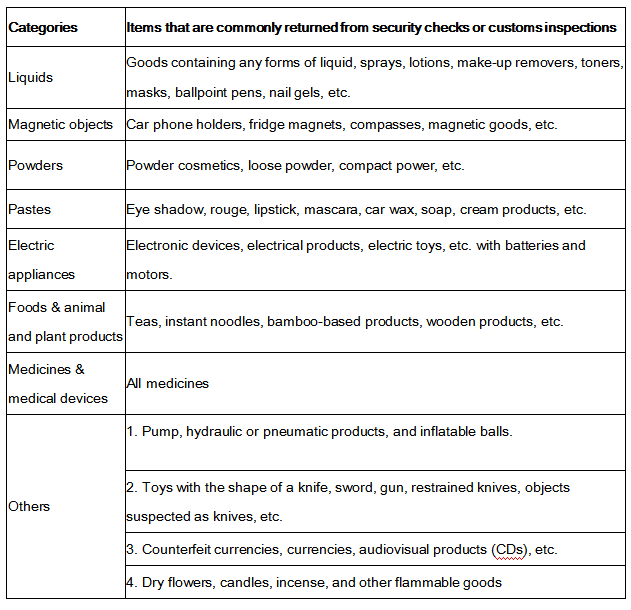
Which number is used depends on the route. Some lines bill on actual weight alone. Others bill on the greater of actual and volumetric weight, where volumetric weight is length times width times height divided by a divisor the carrier sets, and the divisor is not one number. The explanatory article gives two examples, five thousand five hundred for a Hong Kong UPS route and five thousand for DHL; the per-line reference table lists divisors from five thousand up to nine thousand depending on the line and the destination country, and marks several lines as billed on actual weight only. A bigger divisor is better for you, because it converts the same box into fewer kilograms.
That divisor is the difference between a cheap parcel and an expensive one for anything light and bulky. A duvet, a pair of boots in their box, a bag stuffed with paper: all weigh little and price badly.
Afterwards the account settles itself. If the final weight comes in lower, the difference returns to your balance within seven days of delivery. If it comes in higher by one incremental weight unit or more, a balance payment order is raised. Inside one unit, nothing is charged.
Deadlines
Three clocks, and the one that cannot remind you
| Clock | What it costs | Detail |
|---|---|---|
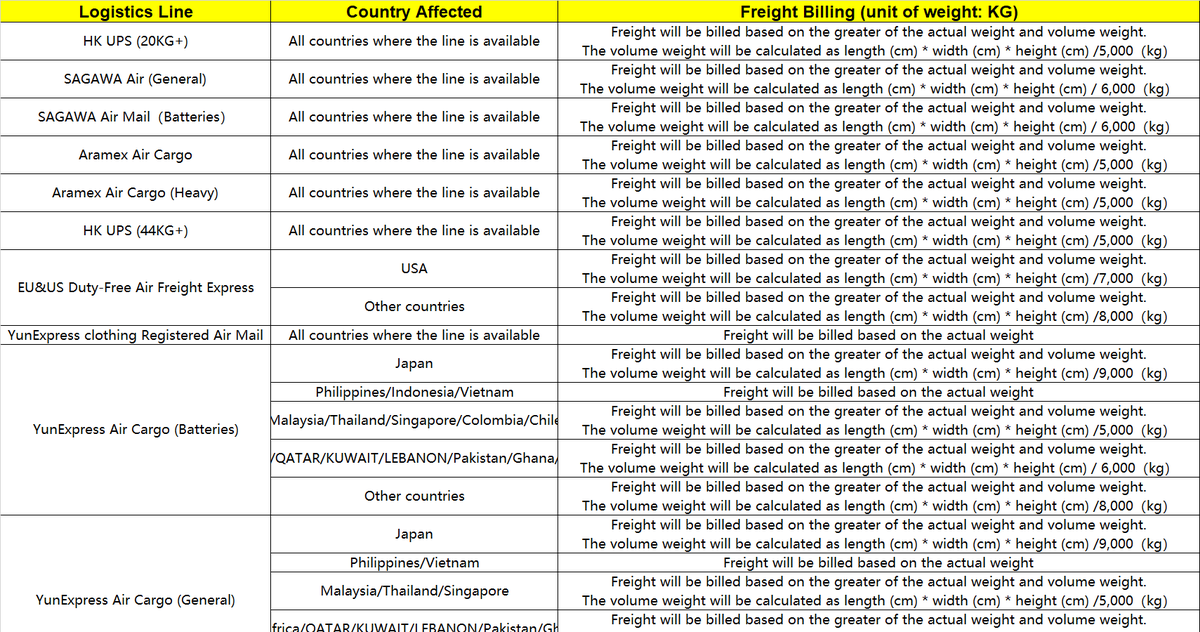
| 90 days | free storage | Counted from the moment the order status turns “Arrived in Warehouse”. |
| Days 91 to 180 | CN¥0.1 per item per day | Charged when you submit the parcel. The article's own worked example: two items held for 100 days cost (100 − 90) × 0.1 × 2 = CN¥2. |
| Past 180 days | disposal | With no shipping order and no reply, the items are disposed of. An extension can be bought in advance at CN¥10 a month, up to six months per purchase. |
| 60 days | abnormal parcels | A parcel signed for with no order submitted, or with incomplete logistics information, is held 60 days from receipt, and the policy states reminders cannot be sent, because there is no order or user attached to it. |
The fourth row is the one that costs people their goods. A parcel signed for without an order attached, or with incomplete logistics information, is held sixty days from receipt, and the policy states outright that reminders cannot be issued because there is no order and no user to attach them to. Silence is not reassurance there; it is the expected behaviour.
One more boundary worth knowing: the operator takes responsibility for storing goods, and explicitly not for their shelf life. Anything perishable, and the policy names a one month shelf life as its example, ages on your clock, not theirs.
Packing choices, which are the cheapest insurance available
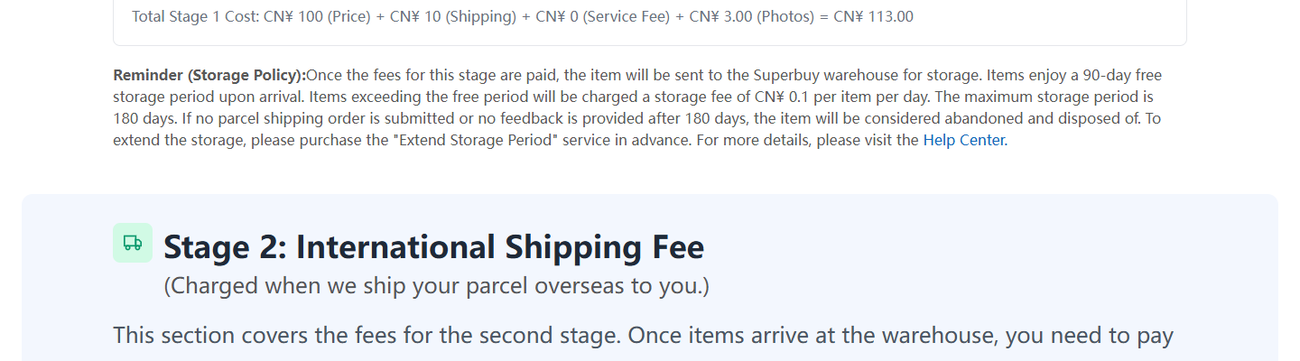
The parcel-level services are a different list from the inspection ones: vacuum packing, moisture-barrier bags, stretch film, corner protectors, loose fill, shoebox flattening, a wooden case for anything that must survive being dropped, and a video of the whole packing process if you want a record.
The choice interacts with billing. Vacuum packing and shoebox flattening cut volume, which matters on a route that bills volumetric weight and not at all on one that does not. Reinforcement adds weight and volume, which is worth it for ceramics and pointless for a hoodie.
If you are shipping anything fragile, decide the packing before the parcel is submitted. Afterwards it becomes a re-handling request, with the delay that implies.
Restrictions
What cannot travel, and what happens when it tries
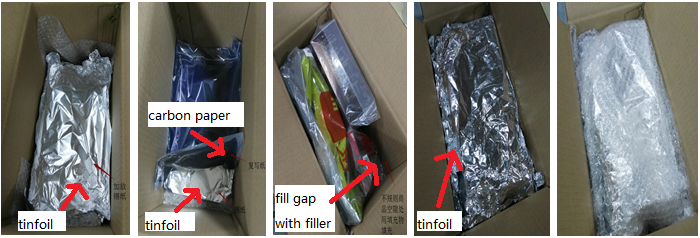
Restricted goods are flagged in the warehouse with a prohibited marker when they arrive. The underlying list is Chinese export law rather than agent policy: weapons and replicas of weapons, counterfeit currency, poisons, narcotics, material harmful to public order, and on the restricted side precious metals, currency, radio transceivers, rare medicines and cultural relics.
Carrier rules sit on top of that and change more often. Batteries, liquids, powders, aerosols and blades move between allowed and refused as lines update their terms, which is why the announcements page is worth a glance before a big order: a notice suspending knife and blade shipments appeared there in July 2026.
On the receiving end, import duty and tax are charged by your own customs on the declared value and the category, and the policy is explicit that this is borne by the recipient. Lines described as tax-prepaid or duty-free move that cost into the shipping price rather than removing it.
For loss and damage, compensation follows each line's own standard and is handled through after-sales. For delay, the help centre is blunt: mainstream couriers publish no delay compensation standard, so there is none.